Introduction
In the modern South African banking landscape, a financial institution’s strength is no longer measured solely by the size of its physical branch network or the total value of its assets under management. While traditional balance sheets, reflecting headline earnings, return on equity (ROE), and customer acquisition rates, remain the bedrock of investor confidence, a new arena of competition has emerged. The battle for consumer trust and deposit market share is increasingly fought on digital screens. The modern consumer’s perception of a bank is shaped daily by social media feeds, community interactions, and real-time responses to customer crises.
This report bridges the gap between traditional financial performance and digital brand equity in South Africa’s banking sector. We analyze how legacy giants such as Standard Bank, ABSA, First National Bank (FNB), Nedbank, and Capitec, leverage their massive financial balance sheets to command attention online. At the same time, we examine how nimble, digital-first challengers like Discovery Bank and GoTyme Bank use high-impact, organic storytelling to punch above their weight. By comparing hard financial metrics with qualitative social media performances across LinkedIn, Facebook, Instagram, and TikTok, we aim to uncover who is truly winning the hearts, minds, and wallets of South African consumers, and who is leaving massive commercial opportunities on the table.
Methodology
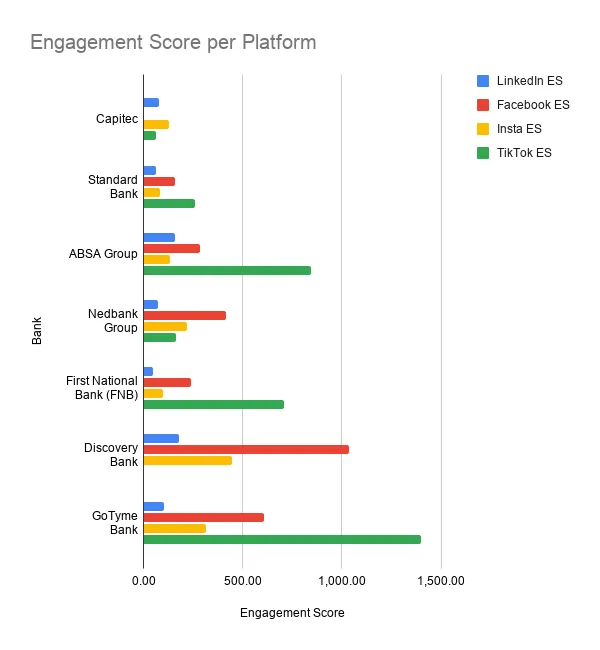
To understand how these brands translate their physical presence into digital attention, we collected and analyzed quantitative performance data over a 15-week period (105 days). Our audit focused on LinkedIn, Facebook, Instagram, and TikTok. We tracked follower counts, posting frequencies, and calculated custom Engagement Scores (ES) designed to neutralize extreme outliers (such as a single hyper-viral giveaway post skewing the entire dataset). This was achieved by utilizing a Winsorized mean, which limits extreme values to reduce the distorting effect of outliers. Facebook ES is the winsorised mean of likes, add the winsorised mean of comments and divide by 2. The ES for other platforms is a winsorised mean of the likes on that specific platform. On Instagram we excluded collaborative posts.
Charts (Results)
Commentary
Capitec Bank
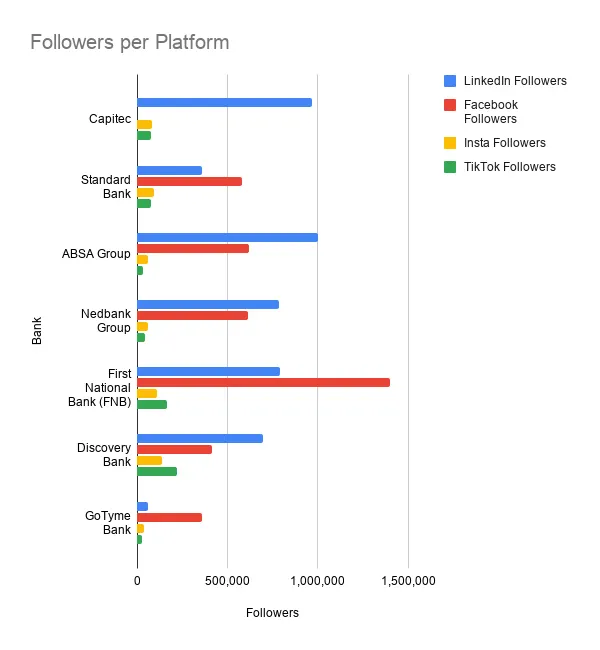
On the financial front, Capitec reported an exceptional set of results for the year ending 28Feb 2025, with headline earnings surging by 30% to R13.7 Billion and active customers climbing past 25 million. However, when you look at their digital assets, they look a bit like an old dog trying to evolve itself. On LinkedIn, it shows they command an imposing presence of approximately 1 million followers, they post corporate fliers, talk about how they support businesses, and share behind-the-scenes staff videos. But explaining behind-the-scenes is always dry; it is best shown, not explained. As a result, much of their day-to-day content feels dull and corporate.
The moments they truly get traction are high-profile corporate updates, such as their stellar financial results or the strategic announcement of Deepesh Desai as the Capitec Life CEO. To capture the younger Gen Z and Millennial demographic, they have started entering the lifestyle and entertainment space on Instagram, using partnerships with events like the local Kota Festival and Comic Con. Their Instagram content actually feels audience-fit, and their reels are genuinely interesting to watch.
The major headache for Capitec remains the comment sections. Across almost every active platform, their posts are completely overwhelmed by users complaining about being scammed. This security perception risk threatens the brand equity that has fueled their 30% earnings growth. Furthermore, Capitec has a massive digital blind spot during this period: they do not have an active, functioning official Facebook page, which is an unbelievable gap for a retail bank with tens of millions of clients.
First National Bank (FNB)
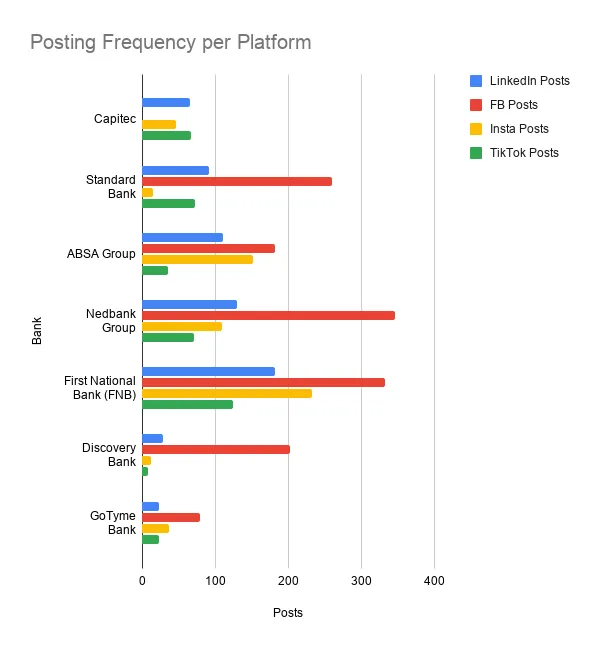
Under FirstRand, FNB delivered normalized earnings growth of 8% to R23.6 Billion in 2025, maintaining the highest Return on Equity (ROE) in the industry at a spectacular 37.4%. A huge driver for this has been non-interest revenue from digital platforms like eBucks. Yet, their digital content strategy is highly polarized. FNB is incredibly aggressive on Facebook, posting more than 300 times. But their brand identity has become almost entirely synonymous with rugby. FNB is essentially rugby before they are even a bank. When they are not posting about rugby or cash giveaways, their day-to-day retail content is dull, salesy, and boring, especially on LinkedIn.
Their LinkedIn articles actually perform quite well, and the bank would benefit greatly from repurposing these insights into shorter, more engaging content rather than pushing standard corporate posts.
Perhaps the most significant missed commercial opportunity for FNB, lies in their unique non-resident account facility. FNB is heavily favored by Zimbabwean non-residents because they are one of the very few institutions offering a workable non-resident channel. Despite this massive advantage, FNB completely ignores this feature in their public marketing. By actively promoting this facility, FNB could easily capture a larger share of the lucrative remittance market, driving low-cost deposits and bolstering their foreign reserves.
Standard Bank
Standard Bank reported massive full-year results with headline earnings rising 11% to R49.2Billion and ROE climbing to 19.3%. This performance was anchored by their Corporate and Investment Banking (CIB) division, which surged 18% to contribute R24.1 Billion to the group. This exact focus on high-level enterprise is instantly clear on LinkedIn, where they execute a near-flawless B2B playbook. They show exactly what level of business they are chasing by showcasing heavy-industry sponsorships such as the Mining Mmogo Awards, Enlit Africa, the Africa Energy Forum, and the Kusi SME National Pitch Challenge. They are focused on manufacturing, mining, energy, and high-growth SMEs.
To prevent their corporate page from becoming too heavy, Standard Bank utilizes an engaging LinkedIn vodcast series that successfully lightens the mood. On Facebook, where they put out over 250 posts, they drive engagement by utilizing interactive puzzles and gaming elements, like their national lotto partnerships. They also capitalize on popular culture, such as the Gas Motorshow International, which makes the massive institution feel highly approachable.
While they enjoyed major reach as a premier partner during the World Cup, the bank did experience localized brand friction during this period due to the Dr. Hammond PR scandal. Nevertheless, Standard Bank’s clear division of B2B corporate messaging on LinkedIn and relatable lifestyle content on Facebook remains highly effective.
ABSA Group
ABSA Group grew its full-year headline earnings by 12% to R24.8 Billion, heavily driven by a massive 51% profit surge in their Africa regions outside South Africa. ABSA’s brand identity on digital platforms can be compared to a classic, wealthy 55-year-old woman who looks 35. She is beautiful, elegant, looks incredibly expensive, and does not have to do much because you can just see she is highly well-kept. ABSA essentially defies the standard social media algorithms by utilizing an enormous paid advertising budget. They push highly glossy, agency-produced videos and premium graphics that feel so luxurious you simply cannot skip them.
The LinkedIn data tells an interesting story about how their audience responds to their content. When ABSA posts standard corporate animations or fliers, the engagement score struggles to pass 100. However, when they feature human-centric stories highlighting their staff, engagement jumps above 100, and key executive appointments easily pull in scores higher than 1000. They also generate solid brand equity by tackling pressing societal issues, such as the agricultural impact of El Niño on food security, and running highly visible campaigns targeting online scammers.
Despite these strengths, ABSA has a serious problem with sponsorship clutter. Within a single three-month window, the marketing team had to cover the ABSA Cape Epic, Masterchef SA, the Wildeklawer school tournament, Agritrends,L’artelier and the Red Bull Symphonic. This creates an overwhelming amount of content that has to be churned out constantly, which confuses both the marketing team and the audience. Consequently, high-value corporate offerings, such as their real estate financing products, are completely drowned out by lifestyle noise because no one has the capacity to focus on them.
Nedbank
Nedbank had a stable, transformative year, with headline earnings up 2% to R17.2 Billion and brand value jumping 20% to R20 Billion. They also expanded their reach by acquiring the SME-focused fintech provider iKhokha for R1.65 Billion. Their marketing team frequently emphasizes that Nedbank is focused on making a real, measurable impact on society, and this is clearly reflected on LinkedIn. They keep stakeholder relations perfectly maintained by showcasing sustainable initiatives like YouthX, their innovation days, the Nedbank Cup, and high-profile roundtables like the National Business Initiative with President Ramaphosa.
Yet, Nedbank is highly active on Facebook, breathing past 350 posts during the period. Despite this massive volume, their Facebook audience is entirely conditioned on giveaways. When Nedbank runs cash promotions or prize incentives, their metrics spike, but the moment these giveaways are absent, their engagement drops off a cliff.
This contrasts sharply with their brilliant execution on Instagram. On Instagram, Nedbank presents an incredibly sophisticated, “bougiee” aesthetic. Their coverage of high-end events, like the International Polo and VIP client sessions at the Montreux Jazz Festival, fits the aspiration of high-net-worth individuals perfectly. It is a fantastic example of tailoring content directly to the unique audience of a specific platform.
Discovery Bank
Discovery Bank reached a major milestone in 2025, reporting its first-ever normalized profit of R75 million as their client base scaled past 1.4 million users. On LinkedIn, the digital challenger focuses on quality over quantity. Their corporate reputation is highly supported by civic-minded initiatives like the “Pothole Patrol.” Pothole Patrol is a brilliant real-world campaign because it is completely unexpected from a bank, giving a digital-only brand a physical, purpose-driven identity that people can see and feel in their daily lives.
However, Discovery Bank’s digital presence sometimes suffers from a lack of human touch. Most of their primary content completely misses real human faces. Also, the bank looks and feels more like an insurance company than a modern, personal digital bank.
Additionally, Discovery Bank’s high Facebook engagement is heavily reliant on “comment to win” sweepstakes. While these puzzles and word search games drive massive superficial numbers, the lack of organic conversational engagement makes one question the actual commercial quality and loyalty of their digital audience. There are also clear missed opportunities, such as their lack of updates on the Discovery Schools Soccer Tournament, which could have been used to drive highly emotional, human-centric storytelling.
GoTyme Bank
GoTyme Bank, which rebranded from TymeBank in early 2026 to align with its international sister operations, surpassed the massive milestone of 10 million customers by late 2025, reaching a valuation of roughly R26 billion. GoTyme executes an absolute masterclass in “quality over quantity” content marketing. Unlike legacy institutions that churn out hundreds of posts a month, GoTyme posts moderately, but ensures every post hits the mark. Their campaign urging followers to “share your financial mistakes so others can learn” is highly relatable and drives massive, authentic user engagement.
GoTyme is also one of the few banks that actively highlights its unique selling proposition (USP). While legacy banks have steered away from talking directly about their product features, GoTyme aggressively highlights exactly why customers should choose them. They communicate their affordable fees and accessible high-yield savings accounts in a modern, digestible format.
Their branding uses vibrant, modern colors and sleek typography, making the bank feel incredibly likable and built for Millennials and Gen Z. They also employ brilliant psychological sales hacks. By branding their standard plastic Visa debit card as a “Travel Card” and highlighting a 0% transaction fee on international online subscriptions (like Spotify and Netflix), they instantly make a basic banking feature feel exciting and aspirational. This strategy has paid off massively, with GoTyme absolutely dominating TikTok with an engagement score of nearly 1400, leaving every legacy bank far behind.
The Consumer Selection Matrix
Based on the quantitative metrics from our 15-week analysis, we can map out which South African bank is best suited for different consumer priorities:
The Modern, Cost-Conscious Retailer — GoTyme Bank The Premium, Lifestyle Consumer — ABSA Group The Corporate & Enterprise Client — Standard Bank The Tech-Savvy, Shared-Value User or Insurance Focused Client — Discovery Bank
Conclusion
Analyzing South Africa’s banking sector reveals a massive difference in how banks handle digital attention. Large legacy institutions like Capitec and FNB enjoy huge, passive follower numbers on paper, yet their day-to-day retail engagement is surprisingly flat. FNB relies almost entirely on rugby and giveaways to keep its metrics alive, while Capitec operates without a primary Facebook presence altogether. Standard Bank and ABSA use their massive corporate balance sheets to maintain high-end, premium brand presence, but they must continuously fight off sponsorship clutter that buries their actual financial products.
Ultimately, challenger banks like GoTyme and a newly profitable Discovery Bank prove that quality of engagement, platform-specific customization, and highly relatable, human-centered storytelling can easily compete with multi-million-rand advertising budgets. In the modern South African banking landscape, digital relevance will always outperform raw legacy scale.